
Important links
Abstract
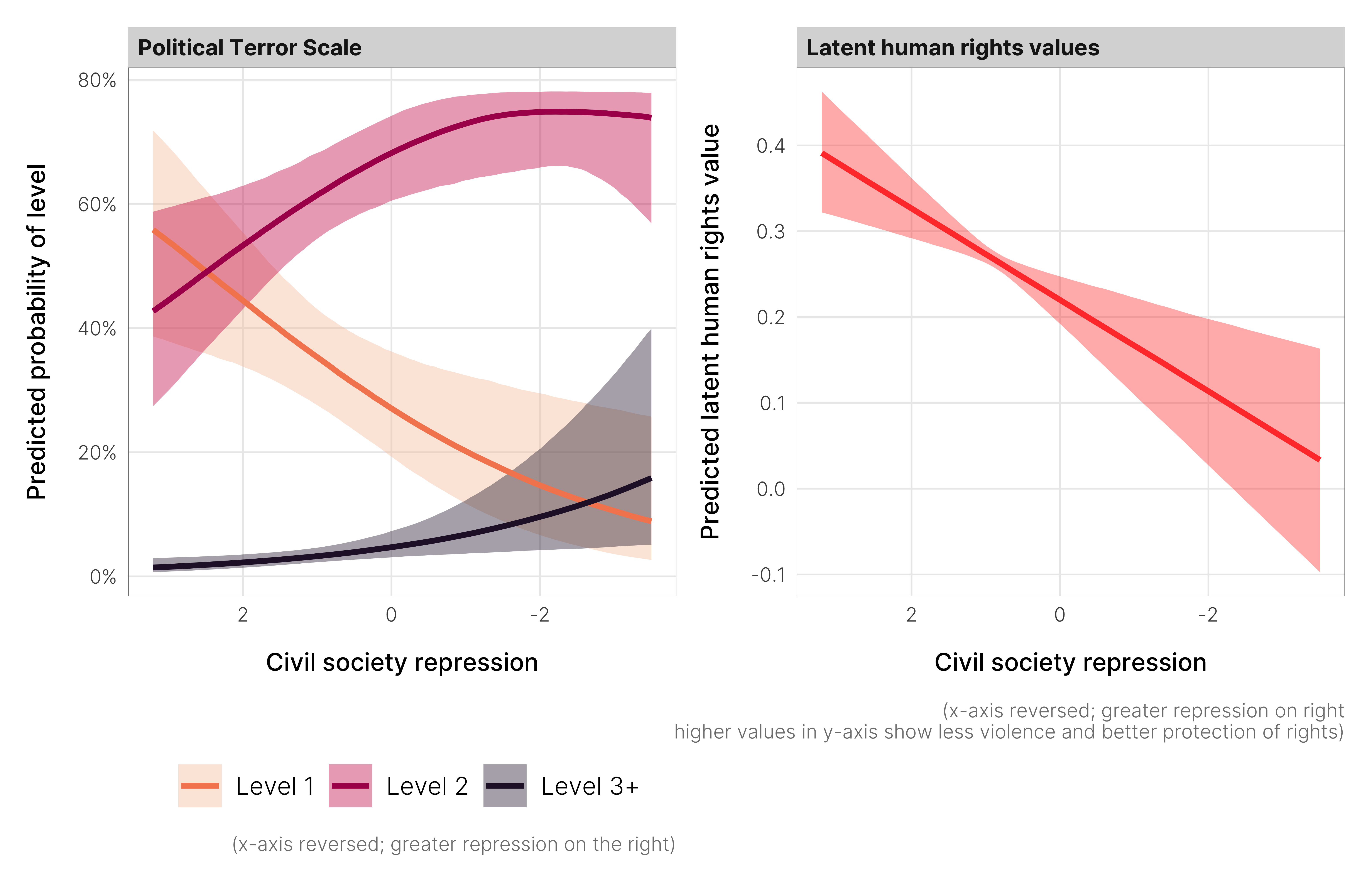
An increasing number of countries have recently cracked down on non-governmental organizations (NGOs). Much of this crackdown is sanctioned by law and represents a bureaucratic form of repression that could indicate more severe human rights abuses in the future. This is especially the case for democracies, which unlike autocracies, may not aggressively attack civic space. We explore if crackdowns on NGOs predict broader human rights repression. Anti-NGO laws are among the most subtle means of repression and attract lesser domestic and international condemnation compared to the use of violence. Using original data on NGO repression, we test whether NGO crackdown is a predictor of political terror, and violations of physical integrity rights and civil liberties. We find that while de jure anti-NGO laws provide little information in predicting future repression, their patterns of implementation—or de facto civil society repression—predicts worsening respect for physical integrity rights and civil liberties.
Important figures
Citation
@article{cruz2023measuring,
  title={Measuring constitutional preferences: A new method for analyzing public consultation data},
  author={Cruz, Andr{\'e}s and Elkins, Zachary and Gardner, Roy and Martin, Matthew and Moran, Ashley},
  journal={Plos one},
  volume={18},
  number={12},
  pages={e0295396},
  year={2023},
  publisher={Public Library of Science San Francisco, CA USA}
}